Physical Security & Offensive Entry
This section treats physical security like a modern attack surface, not a nostalgia niche. By the end, you should be able to scope a lawful on-site engagement, map facility attack paths, evaluate access-control architecture, run offensive entry tradecraft, validate surveillance coverage, and deliver remediation that makes sense to security operations, facilities teams, and leadership. The offensive material stays here on purpose, but it is now wrapped in stronger assessment methodology.
Why This Section Matters Now
Technology Shifts That Change Assessments
Assessment Tiers
Use these tiers to decide how far you need to go. Not every office needs covert entry against maglocks, but every client should understand where visitor controls, surveillance, and access architecture actually break.
Reception desk, badge readers, shared workspace, conference rooms, and standard camera coverage.
- • Sections 01-02: recon, threat modeling, visitor and social workflow testing
- • Sections 04 and 06: access control validation and reporting
- • Optional offensive track: sections 03, 08, and 09
Multiple buildings, loading docks, contractor flows, security staff, network closets, and surveillance blind-spot problems.
- • All Tier 1 work, plus sections 05, 07, and 10
- • Validate device implant risk, RF paths, and surveillance architecture
- • Treat human behavior and camera placement as one control system
Data centers, healthcare, industrial environments, executive spaces, or sites with biometrics, guards, and formal audit obligations.
- • All Tier 2 work, plus sections 11-12 for standards and playbooks
- • Stronger legal, safety, and emergency coordination requirements
- • Findings must map cleanly to auditors, facilities, and security ops
What You Will Learn
Prerequisites
Legal and Safety Baseline
- • Written authorization with clear timing, scope, and emergency contacts
- • No ambiguity around police, guards, life-safety systems, or after-hours rules
- • Explicit agreement on impersonation boundaries and prohibited roles
Operator Readiness
- • Comfort with OSINT, note-taking, timekeeping, and evidence hygiene
- • Basic understanding of access control, cameras, and workstation/network objectives
- • Ability to stop when scope, safety, or law enforcement posture changes
Recommended Context
- • Read OSINT first for personnel and facility profiling
- • Pair this section with Wireless Security for RF-heavy sites
- • Keep Legal Compliance open if this is your first on-site engagement
How To Use This Section
Consultants
Move from sections 01 through 06 in order. That gives you a repeatable assessment workflow before you escalate into specialized offensive tradecraft.
Red Teamers
Use sections 01-02 for reconnaissance and persona prep, then live in 03, 04, 07, 08, and 09. Section 05 keeps the post-entry actions objective-driven instead of opportunistic.
Defenders / Facilities
Focus on 01, 02, 04, 06, 10, and 11 to understand why badging, visitor control, surveillance, and reporting often fail as a connected system.
Methodology Overview
From authorization to offensive entry to standards-aligned reporting
Quick Start: Assess a Corporate Office in 15 Minutes
If you need a practical entry point, use this mini flow to sanity-check a facility before you go deeper. It keeps the offensive mindset, but forces you to observe the whole control system instead of fixating on the first unlocked door.
site: Corporate office with lobby, badge readers, cameras, and standard workstation footprint

1. Start outside
   - Count public entrances, delivery entrances, and smoking / break areas
   - Identify camera coverage, guard posture, and likely blind spots
   - Note whether reception can see the primary badge-controlled doors

2. Threat-model the first three realistic attack paths
   - Tailgate behind a lunch crowd
   - Pretext through reception as contractor or visitor
   - Clone or emulate a credential if the site uses weak badge tech

3. Validate the control chain
   - Does reception verify identity or only issue a temporary pass?
   - Are visitors escorted?
   - Are doors anti-passback, monitored, and alarmed?
   - Do cameras actually cover the route to sensitive rooms?

4. If entry succeeds, stay objective-driven
   - Identify exposed workstations, network drops, badge stock, and server / telecom rooms
   - Decide whether a rogue device, photo evidence, or minimal proof-of-access is enough

5. Write the finding in control language
   - What failed first: people, process, hardware, or monitoring?
   - What would have detected or interrupted the route?
   - Which standard or policy requirement does it violate?
Physical Security Stack (2026)
| Tool / Resource | Category | Best For | Integration |
|---|---|---|---|
| Proxmark3 | Badge / RFID | Low- and high-frequency credential analysis, dumps, and cloning workflows | Badge attacks, reader baselines, mobile credential migration checks |
| Flipper Zero | Portable RF Ops | Field-ready RFID, Sub-GHz, infrared, and BadUSB testing | Portable on-site assessments and rapid validation |
| HackRF One | RF Analysis | Wide-spectrum signal work where handheld tools are not enough | Garage gates, wireless sensors, and spectrum analysis |
| Camera Coverage Planner | Surveillance Validation | Coverage zones, blind spots, and route analysis | Interactive planning during surveillance reviews |
| Biometric Defense Evaluator | Biometric Testing | Face, gait, and voice checkpoint evaluation | Biometric validation, anti-spoofing awareness |
| LAN Turtle / Shark Jack | Implants | Rapid internal footholds after physical entry | Network drop validation and segmentation testing |
| O.MG Cable / Hardware Keylogger | Device Access | Short-duration workstation and conference-room tradecraft | Objective-based post-entry actions |
| Reporting Templates | Delivery | Executive writeups, evidence structure, and severity normalization | Use with the documentation chapter and report-builder workflow |
Why The Offensive Tools Still Matter Here
Guide Sections
Recon & Threat Modeling
Map facility attack paths, people flow, security layers, and defender routines before you ever touch a badge reader or door.
OSINT • Site walks • Patterns of life • Attack paths
Visitor Controls & Social Engineering
Test reception workflows, escort rules, challenge culture, and pretexts that determine whether unauthorized people get normalized.
Pretexts • Visitor logs • Call-backs • Challenge culture
Locks, Doors & Bypass
Keep the offensive heart of the section: pick, shim, bypass, and assess mechanical controls without losing sight of what defenders should fix first.
Lock picking • Latch bypass • Door hardware • Non-destructive entry
RFID & Access Control
Cover badge cloning, mobile credentials, Wiegand-to-OSDP migration, reader placement, and access-control architecture weaknesses.
Proxmark3 • Mobile badges • OSDP • Reader security
Rogue Devices & Post-Exploitation
Turn entry into objective-driven access with network implants, hardware keyloggers, evil-maid workflows, and concealment-aware evidence collection.
LAN Turtle • O.MG Cable • Evil Maid • Network drops
Evidence & Reporting
Document the route, control failures, detection gaps, and remediation path clearly enough for legal, executive, and operations teams to act on.
Timelines • Photos • Severity • Reporting pack
Flipper Zero & RF Ops
Portable offensive workflows for Sub-GHz, RFID, NFC, BadUSB, infrared, and field-ready signal capture during on-site operations.
Sub-GHz • NFC • BadUSB • Firmware workflows
Tailgating & Impersonation
Pressure-test human behavior at the door with believable personas, body language, queue timing, and challenge-response observations.
Tailgating • Persona design • Props • Human factors
Covert Entry & Alarm-Aware Bypass
Advance into maglocks, REX sensors, under-door tools, and covert bypass patterns while staying anchored to scope and defender lessons.
REX • Maglocks • Under-door tools • Alarm awareness
Surveillance & Biometrics
Assess camera placement, coverage quality, ONVIF exposure, PTZ timing, biometric checkpoints, and anti-spoofing expectations.
Cameras • ONVIF • Coverage zones • Biometrics
Standards & Case Studies
Map findings to NIST CSF 2.0, ISO 27001, UL 294, OSDP, and real-world failures so recommendations land with auditors and operators.
NIST CSF 2.0 • ISO 27001 • UL 294 • OSDP
Reference Checklists & Playbooks
Use ready-made checklists, quick-start playbooks, offensive decision trees, and reporting scaffolds to run repeatable physical engagements.
ROE • Checklists • Playbooks • Templates
Quick Reference
Core Principles
- • Threat-model the route before you test the route
- • Keep offensive activity tied to an agreed objective, not curiosity
- • Measure people, process, hardware, and monitoring as one system
- • Document what would have interrupted the attack path earliest
Current Standards and References
- • NIST CSF 2.0 - Govern, Protect, Detect, and response mapping
- • ISO 27001 / 27002 - physical perimeters, monitoring, and media handling
- • UL 294 - access-control hardware assurance and deployment quality
- • OSDP Secure Channel - modern replacement for exposed Wiegand links
Ready to Begin?
Start with reconnaissance to map the facility like an attacker, move into visitor and access-control testing, and then choose how deep you need to go into bypass, RF tooling, rogue devices, surveillance, and standards alignment.
Start the Guide📚 Recommended Reading
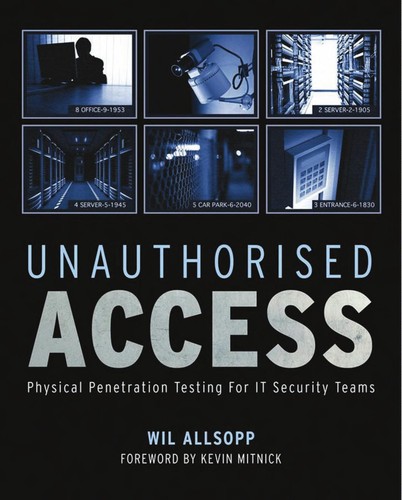
Unauthorized Access: Physical Penetration Testing for IT Security Teams
Wil Allsopp (2009)
The definitive guide to physical intrusion testing — covers lock bypass, access control defeat, social engineering pretexts, covert entry, and professional reporting for red teams.

Social Engineering: The Science of Human Hacking
Christopher Hadnagy (2018)
Comprehensive framework for influence, elicitation, and pretexting — the human-side techniques that make physical penetration tests succeed or fail.
🛠️ Recommended Tools
Flipper Zero
Multi-tool for Sub-GHz, NFC, RFID, IR, and BadUSB attacks.
Proxmark3
Gold-standard RFID/NFC research tool for badge cloning and access control testing.
HackRF One
Wideband SDR (1 MHz – 6 GHz) for deep RF analysis and signal replay.
SouthOrd Lock Pick Sets
Professional-grade picks for SPP, raking, and bypass testing.
Body Cameras
Discreet 1080p cameras for engagement evidence capture.
Related Guides, Tools, and Resources
OSINT
Pre-engagement collection for facilities, staff, and vendor footprint.
Counter-Surveillance
Camera discovery, blind spots, and biometric-aware environments.
Internal Network
What to do once physical access turns into internal network access.
Wireless Security
Blend on-site entry with RF, Wi-Fi, and Bluetooth testing.
Camera Coverage Planner
Interactive camera mapping and blind spot analysis.
Biometric Defense Evaluator
Hands-on biometric validation and anti-spoofing exploration.
Legal Compliance
Rules of engagement, authorization language, and insurance considerations.
Reporting Templates
Executive summaries, evidence handling, and formal deliverables.
As an Amazon Associate I earn from qualifying purchases.