ARTEX Autonomous Pentest Platform
ARTEX is a self-hosted platform where a planner agent directs worker agents at real tools, and every finding stays attached to the assets and HTTP traffic that support it. It is written in Go, depends on PostgreSQL, and treats the evidence trail as the product rather than a report you assemble afterwards.
Authorized use only
Architecture Overview
The design rests on two graphs that are kept apart on purpose. One describes the target estate and is shared by every task; the other describes one line of reasoning and is thrown away with the task.
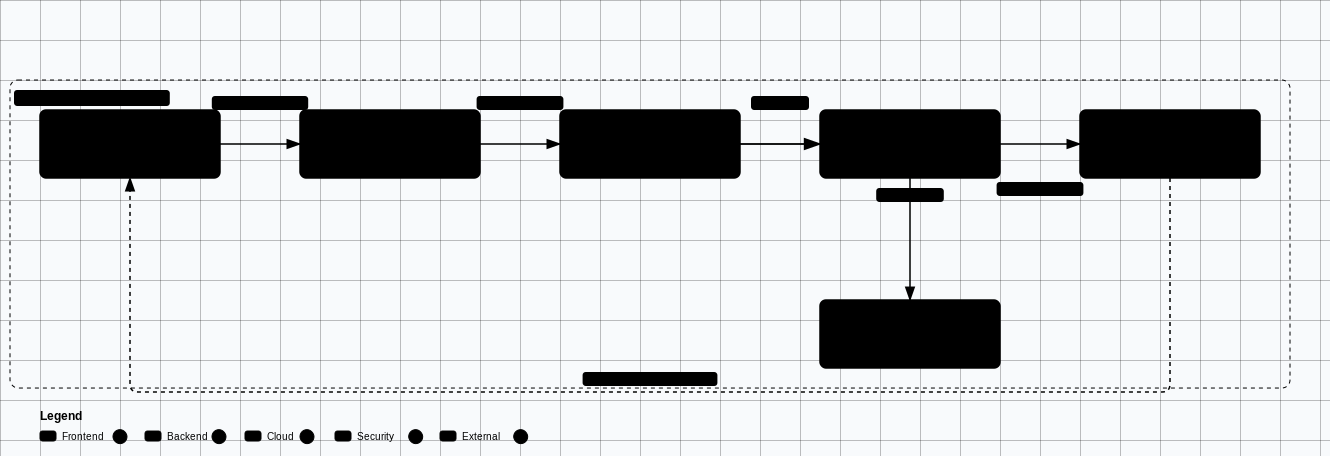
ARTEX evidence-bound agent loop
Scroll sideways to see the whole diagram
| Graph | Nodes | Role |
|---|---|---|
| Asset graph | root_domain, subdomain, ip, service, app, endpoint | Shared across tasks and owned by a company record. Agents submit raw observations; parent-child relations and dedup keys are computed by the platform. |
| Exploration graph | goal, intent, fact, finding, hint | Created per task. Edges (spawns, derived_from, yields, proves) form the lineage from a goal down to the traffic that proves a finding. |
| Anchors | exploration_anchors(node_id, asset_id) | Joins the two graphs. This is what makes per-asset test coverage and the coverage graph possible. |
Agents never write to the asset graph directly. They report what they observed, and the platform decides whether a host is a new subdomain of a known root domain or a duplicate of something already recorded. That keeps two workers from inventing two spellings of the same asset, and it stops a hallucinated hostname from entering the estate until something observed it.
Two integrations feed the two halves of the design. Assets can be pulled from ScopeSentry by project or task and merged into a company scope, so an inventory that already exists does not have to be retyped. MCP servers registered over Streamable HTTP or the older SSE transport, with a bearer token, appear to agents as tools alongside the scanner toolchain bundled in the image.
The Loop
The engine is event-driven rather than a fixed pipeline. A change in either graph wakes the planner, which reads the current situation and dispatches zero or more intents, each carrying the assets it applies to. A worker claims one intent, fetches the raw assets, runs the tool through the recording proxy, and writes back facts, assets and findings. Those writes wake the planner again.
Most wake-ups dispatch nothing. That is the termination condition: when the planner reads the graph and has no next step that the facts support, the task winds down rather than looping on the same dead end. A task ends when the goal is proven, the budget runs out, or an operator stops it.
Long chains survive across wake-ups because the planner keeps a todo list for the task and releases the next step only when earlier steps produced the facts it requires. Workers are confined to the intent they claimed, but they can search each other's traces. An observation that never became a formal fact, such as an error string or a parameter that only appears in one response, stays available to the next worker instead of being discarded at the end of a run.
Evidence Model
Every tool call that leaves the platform passes through a man-in-the-middle proxy on port 8788 with a generated CA. The request and response are stored and bound to whatever finding the call produced, so a report line can be traced back to bytes on the wire. Bodies compressed with gzip or deflate are decoded before the evidence check runs, which matters because the check looks for verbatim quotes.
Findings carry a proof-of-exploitation level, a verification status and a note. A finding is marked verified only when a bound proof exists and the quoted evidence appears in the captured response. For targets behind a login, a browser extension captures the authenticated session once, including captcha, email OTP and 2FA steps, and posts text request and response pairs to the ingest endpoint. Binary bodies are skipped, bodies are truncated at 256 KiB, and batches are capped at 50 entries.
A separate retest agent re-runs a finding later, optionally against a fixed version or different conditions, and records one of Still reproducible, Fixed or Cannot confirm. It can move a finding to fixed automatically. The original evidence and the report stay in place, so the history of a finding is additive.
What the proxy does not cover
Coverage And Cost
Coverage is the figure a client asks for and the one most tools cannot produce. Here it comes from the workers. Each one calls record_coverage as it finishes a surface, recording per risk class whether it examined the surface, ruled it out, or left it open. Those entries reach the planner on the next wake-up, so an untouched login form can pull the next intent toward it instead of ending up in a closing slide.
The same data is exposed over the API, which matters when the report is assembled outside the platform.
| Endpoint | Returns |
|---|---|
| GET /api/tasks/{id}/coverage | What the task examined, ruled out or left open for each surface and risk class, which is also what the planner is given when it decides the next step. |
| GET /api/tasks/{id}/outcome | What the task produced and what it cost: findings by disposition and severity, retest verdicts, tokens, tool calls, skill misses and wall time. |
| GET /api/settings/noise | Per-host counters from the noise governor, the same figures the Target noise card renders. |
Cost is reported with it. Token use is counted per task and per session, including cache reads and writes, and every model call has a record you can open. The task outcome reports token spend, tool calls, skill misses and wall time next to the findings, so a run that produced nothing can still be read as an expensive run rather than a quiet one.
Starting From Scan Output
A task does not have to begin empty. The ingest_scan_output tool parses nmap XML, nuclei JSONL, httpx JSONL and ffuf JSON into graph nodes, so the output of a scan that already ran becomes a starting position instead of a file someone reads by hand. Files are capped at 256 MB and resolved only inside the run's working directory: a path containing a parent-directory element, or one that resolves outside that root through a symlink, is refused.
How It Avoids Fooling Itself
Detection is the cheap half of testing. The expensive half is deciding that what a scanner printed is real, and the failure mode of an autonomous agent is a plausible report full of unexamined guesses. Three mechanisms in the codebase address that, and only the first one is a prompt.
The Adversarial Gate
The worker and pentest prompts require a candidate to be actively disproved before it is reported, with eliminations held to the same evidential bar as confirmations, distinct candidates left unmerged, and zero confirmed findings treated as a valid result. The retest agent is given the opposite instruction on purpose: it argues against the finding and has to cite the specific requests, responses or controls it relied on. The seed text is adapted from VulnHunter, which is Apache-2.0, and a public bug-bounty prompt collection under MIT.
What a zero-findings run means here
Repetition And Large Tool Sets
Repeated intent directions are grouped and surfaced to the planner, so a run that keeps enumerating the same API under three versions is told it is repeating itself and can change course. Tool selection has a second bound: with ARTEX_TOOL_RAG enabled the agent receives a narrowed list chosen from the tools it was already allowed to use, twelve non-essential tools by default and configurable through ARTEX_TOOL_RAG_TOPK. The filter can only remove tools, never add one that was not bound, and a small catalogue is passed through whole. It is off by default.
Lessons Stay In Shadow
The repository carries a written contract for self-improvement that is worth reading before anyone describes the tool as learning on its own. Lessons can be extracted from closed tasks under ARTEX_RSI_LESSONS=off|shadow|inject. In inject mode they are appended after the planner and worker system prompts inside a code-owned block that tells the model to read them as data. The document sets out three loops and states plainly that only the first two exist: gain within a task, and retained lessons in shadow mode. The loop that would edit the agent's own prompts and skills is not built, and its contract forbids a live task from ever justifying an adoption. The adversarial and quality gates, scope and authorisation checks, prompt-injection defences and tool allowlists are declared outside the search space, and a lesson changes status only by owner action.
Gates And Limits
The controls are the part worth evaluating before a trial run. Several of them are off by default, and the defaults are the ones you will get if you install it and start a task.
| Control | What it does | How to set it |
|---|---|---|
| Tool-call interception | Holds each Bash or HTTP call for approval when a matching rule is configured. Rules can be a plain string, a regular expression, or an argv prefix. | Rules in the interception UI; each approval records who decided — human, rule, model or system. |
| Scope | Assets outside the declared scope are not explored, and scope rows define the denominator for coverage reporting. | Scope rows on the company record. |
| Target gate | Refuses destinations that were never approved. Off by default and currently API-only. | Target-gate configuration through the API. |
| Task and intent budgets | Caps tokens and turns for the whole task and separately for a single worker run. Unset or zero means no limit. | ARTEX_TASK_BUDGET_TOKENS, ARTEX_TASK_BUDGET_TURNS, ARTEX_INTENT_BUDGET_TOKENS, ARTEX_INTENT_BUDGET_TURNS |
| Noise governor | Paces requests per host, adds jitter, honours Retry-After on 429 and 503, and caches GETs. It is best effort, not a security boundary. | ARTEX_NOISE_PROFILE=quiet|balanced|aggressive, or the Target noise card at runtime. |
| Untrusted-output boundary | Frames tool output as data between nonce-tagged markers so the model does not read a scanned page as instructions. Costs about 154 bytes per tool result. | On by default; ARTEX_UNTRUSTED_BOUNDARY=0 disables it. |
The argv-prefix rule is the one with a sharp edge. A rule is a JSON array of one to eight tokens, matched against exactly one simple command. Pipes, lists, redirections, subshells, background jobs and variable assignments do not match it, and neither do wrapper programs. Flags are ignored by construction, so a ["git","push"] rule covers a forced push but not a push run through a wrapper. Read the rule as a guard rail for the common case; an agent that wants to route around it has room to do so.
Budgets live in memory. A restart resets the counter, so a task that outlived its budget can continue after one. Below roughly 50,000 tokens no worker is started at all, and the 50,000 to 70,000 range typically buys a single worker before the task enters forced wrap-up. Concurrency defaults to three work agents per task. Set the numbers from what a real run costs, not from what looks generous.
Installation
There is no prebuilt image on a registry: the Docker image is always built from the checkout you cloned. The guided installer offers an all-Docker or a local-build path.
1. Guided Install
git clone https://github.com/BaaRai/ARTEX.git
cd ARTEX
./install.sh
2. Or Compose By Hand
cp .env.example .env
# set POSTGRES_PASSWORD, and an LLM API key or a local Ollama endpoint
docker compose up -d --build

# the one-time setup token is printed at startup
docker compose logs artex | grep "Setup token"
The UI, API and event stream listen on port 8787, and the recording proxy on 8788. The UI binds to 127.0.0.1 unless you set ARTEX_BIND_ADDR to expose it. The image ships a scanner toolchain that includes nmap, nuclei, httpx, katana, ffuf, dalfox, sqlmap, ripgrep and curl; the skills and data directories are bind-mounted from the checkout.
Configuration is thin on purpose. The config file carries the database block and the skill directory, and both have an environment override, so ARTEX_PG_DSN and ARTEX_SKILL_DIR win over the file, which ARTEX_CONFIG can move somewhere else entirely. Model keys, budgets and noise profiles are set in the environment or in the settings UI. Both listeners move with the start script: ./start.sh -addr :8787 -proxy :8788.
Release checkouts
Operations
Four operational details account for most first-week failures.
Secrets at rest
Credentials are encrypted with AES-256-GCM under keys/secret.key, or under ARTEX_SECRET_KEY as 32 bytes in base64 or hex. A database backup without the key directory restores nothing that was encrypted, and the server refuses to start when encrypted secrets exist and no key is available.
Model endpoints
Profiles can fail over between Anthropic, OpenAI, OpenAI-compatible relays and a keyless local Ollama instance. The Anthropic base URL takes the host without /v1, because the platform appends /v1/messages; the OpenAI format base URL does end in /v1.
Logins behind a proxy
Login is limited to ten attempts a minute per client IP. Behind a reverse proxy, set ARTEX_TRUSTED_PROXIES to the proxy CIDRs so the forwarded address is used; with an empty default every client appears to share one address, and one noisy client can lock the rest out for up to fifteen minutes.
Streaming
The live view is server-sent events. A proxy in front of it needs buffering off and a long read timeout, or the interface appears to stall while the task keeps running.
Backups
The checkout ships a backup script that dumps PostgreSQL and optionally the data directory, with rotation. Snapshot the keys/ directory alongside it: the dump holds encrypted secrets, and the key that decrypts them lives in a file.
scripts/backup.sh --with-data   # database dump plus data/, rotate at 14
scripts/backup.sh --keep 7        # database only, keep 7 copies

# restore into a running stack
gunzip -c backups/artex-db-<timestamp>.sql.gz \
  | docker compose exec -T postgres \
      psql -U "$POSTGRES_USER" -d "$POSTGRES_DB"
Upgrades
Restarting the new binary is the upgrade. On every start the platform applies its embedded schema baseline and then any pending numbered migration, in order and each in its own transaction, so there is no manual database step. The PostgreSQL volume, the data directory, the key directory and the skills directory survive the swap; back up the first three before you take one. The one-click update script pulls and offers either a Docker rebuild or a local rebuild.
A clone taken before the project's history was rewritten cannot fast forward, and the update script stops rather than rebuilding stale code. Fetch and hard reset it once, then upgrade normally. Checking for new releases is opt-in through ARTEX_UPDATE_CHECK=1, which asks the public releases API at most once a day; unset, the platform makes no update request.
Behind A Reverse Proxy
Port 8787 serves the interface, the API and the event stream from one origin, so exposing 443 and keeping 8787 internal needs no second origin for streaming. Buffering has to be off, or the browser connects and receives nothing.
server {
    listen 443 ssl;
    server_name artex.internal.example.com;

    location / {
        proxy_pass http://127.0.0.1:8787;
        proxy_set_header Host $host;
        proxy_set_header X-Forwarded-Proto $scheme;
        proxy_set_header X-Forwarded-For $proxy_add_x_forwarded_for;

        # the event stream stays silent without these
        proxy_buffering off;
        proxy_cache off;
        proxy_read_timeout 3600s;
        proxy_http_version 1.1;
        proxy_set_header Connection "";
    }
}
Then fix client attribution. With the binary on the same host as the proxy, the peer address is the loopback address. With the container behind a host proxy, the connection arrives from the Docker bridge gateway, which docker network inspect <project>_default reports as the first IPAM gateway. Add that address, and only addresses you run, to ARTEX_TRUSTED_PROXIES. A trusted peer can claim any client address, so a wide list is worse than none.
How It Has Been Used
On 13 November 2026 the FBI published a FLASH advisory on the framework itself, numbered
FLASH-20261113-001.
It records multiple actors using ARTEX since at least August 2026 against financial, government, technology,
defence, semiconductor, energy, healthcare, manufacturing, telecoms and legal organisations, and states that
some intrusions went from first targeting to privileged access in the cloud in under three hours. Two campaigns
carry most of the detail:
- South Korean financial institutions, where personal information on roughly 67,000 people was taken. A later police case in the same country covered more than 90 organisations and about 8.2 million records, with ARTEX reported as the tool used in most of the intrusions.
- ConnectWise Cloud Backup, where stolen application identities were used to attempt sign-in at more than 2,250 downstream Microsoft 365 tenants. Microsoft attributed that campaign to Storm-0940 and described the framework as what turned reconnaissance, password spraying and OAuth abuse into machine-speed work.
The advisory also notes that the original repository came down on 8 October 2026 after reports of abuse, and that the framework remains available through forks, mirrors, localised builds and a paid edition. Researchers counted more than 1,600 ARTEX consoles reachable from the internet in early November. That number is worth sitting with: every one of those hosts has a shell that answers commands from a language model, on a network the operator may not have mapped.
What this changes if you deploy it
-
Never expose the console. It binds
127.0.0.1by default, andARTEX_BIND_ADDRshould point at a private address behind a VPN or proxy, never at a public interface. - Pin and diff the build. Forks and repackaged editions are where an unauthorised change would hide, and the checksums, SBOM and build attestation cover the maintainer's releases only.
- Watch for egress you did not plan. A host that talks to a model provider you did not configure, or to a webhook or tunnel service, is the signal the advisory asks defenders to hunt for.
Where It Fits
Good fit
Repeated assessments of an estate you already hold a company record for, where the deliverable has to survive review. The coverage ledger answers which assets were tested, and the evidence trail answers what supports each line of the report. The retest loop turns a fixed finding into a dated record instead of a claim in an email.
Poor fit
A one-off external test of a single web application, or anything where nobody will administer the platform. It asks for PostgreSQL, a key directory you back up, a model endpoint you can explain to the client, and someone watching the interception queue.
Before any run
Decide what a verified finding means in your engagement. If the client needs a human-confirmed exploit, the retest agent and the quote check narrow the review queue but do not replace it.
Preflight Checklist
- Set POSTGRES_PASSWORD in .env, and confirm where the LLM endpoint physically is before the first run.
- Back up keys/ with the database. A database backup without the key directory cannot restore the encrypted secrets.
- Claim the install through /setup using the one-time token from the startup logs, then set the bind address deliberately — the UI listens on 127.0.0.1 unless ARTEX_BIND_ADDR says otherwise.
- Write the scope rows for the engagement before pointing ARTEX at anything, and check the coverage ledger shows the assets you expect.
- Add interception rules for anything destructive, and decide in advance who approves tool calls and how often.
- Set a task budget, and read the wrap-up behaviour in the logs on a lab run so you know what a truncated task looks like.
Due diligence before ARTEX goes near a client
- The licence is AGPL-3.0. Running a modified version as a network service obliges you to offer its complete source to the people who use it, which is a question for legal before it is a question for engineering.
- This repository is an English translation and continuation of an earlier project by a different author. The author removed the original repository on 8 October 2026 after reports that the framework was being abused, so the lineage cannot be checked against it, and forks, mirrors, localised builds and a paid edition circulate. Pin a commit hash and diff it before trusting a build you did not clone yourself.
- Its history was rewritten to remove a personal email address. A clone taken before that rewrite cannot fast-forward, so re-clone rather than pulling.
- The published material describes capability and design, not measured results against a third-party benchmark. Score it in your own lab against a manual baseline before you quote anything about coverage.
- Support covers the latest release line only. The main branch is not a stable release, forks and custom builds are outside official support, and vulnerabilities are reported privately through GitHub Security Advisories rather than a public issue.
Project Links
ARTEX
Self-hosted multi-agent pentest platform in Go with a recording interception proxy and evidence-bound findings.
DarkMoon
MCP-gated autonomous pentest orchestrator with a local privacy gateway.
HexStrike AI
MCP tool server exposing 150+ security tools and 12+ agents to AI clients.
PentestGPT
Automated penetration testing agentic framework powered by LLMs.
Related Offensive AI Guides
Autonomous AI Pentest Platforms
Where ARTEX sits against DarkMoon, HexStrike AI and the managed platforms.
DarkMoon
The other self-hosted autonomous option, behind a local privacy gateway.
HexStrike AI
The tool-server approach: give an AI client a large arsenal and drive it yourself.
MCP Security
Securing the MCP servers ARTEX can call as tools.